
What is LoRaWAN?
A Long-Range, Low-Power IoT protocol designed for smart buildings, industrial monitoring and scalable connected environments.
What is the LoRaWAN Protocol?
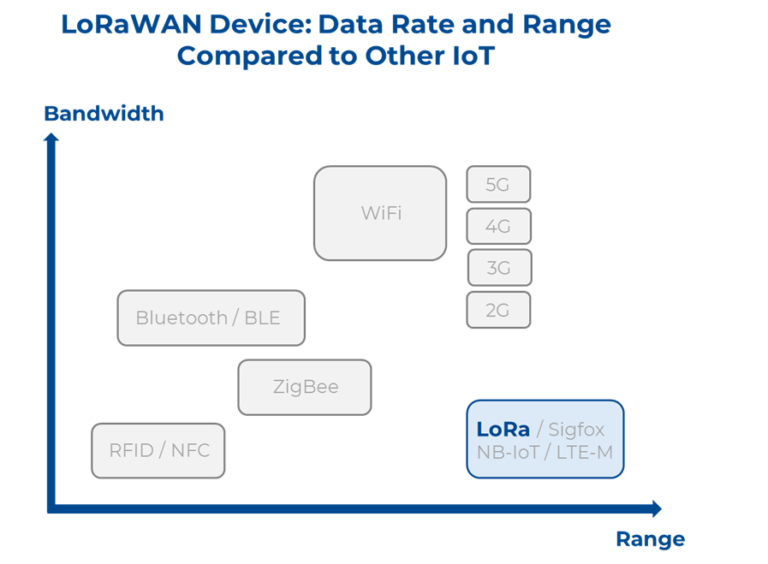
LoRaWAN, short for Long Range Wide Area Network, is a wireless communication protocol designed for IoT (Internet of Things) networks. It uses LoRa technology — a spread-spectrum radio modulation — to enable long-distance communications with minimal energy consumption.
By structuring data exchanges between devices, gateways, and servers within an LPWAN (Low Power Wide Area Network), LoRaWAN ensures reliable connectivity, enhanced security, and high scalability — addressing the diverse needs of connected environments.
LoRa is the radio modulation technology.
LoRaWAN is the protocol that manages connectivity, security and routing for IoT devices within the network.
How Does LoRaWAN Work in IoT Networks?
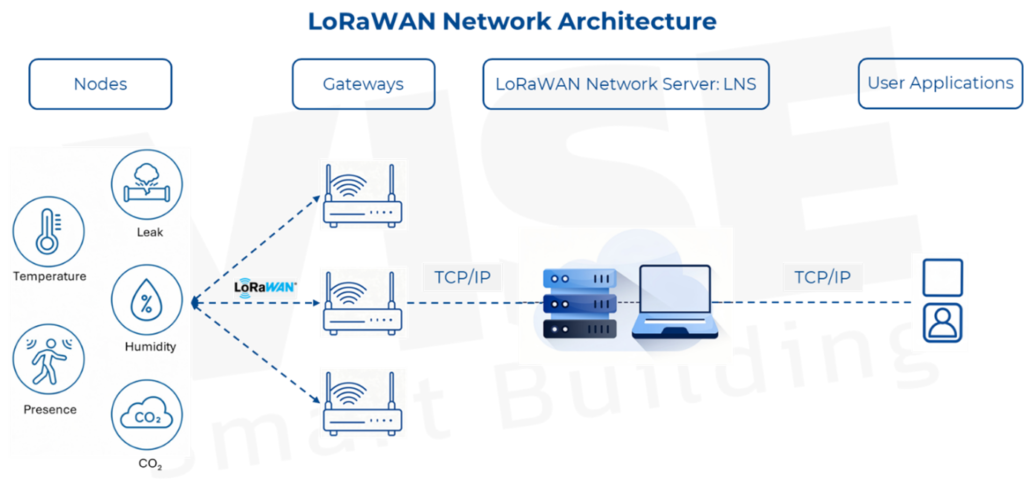
LoRaWAN operates based on the interaction of four key components, each with a specific role in the data transmission chain.
IoT devices such as temperature, humidity, or air quality sensors that measure and transmit data to gateways via LoRa radio signals.
Capture radio signals from nodes and forward them to the network server, acting as concentration points to ensure extended coverage.
Manages communications between gateways and nodes — ensuring message authentication, duplicate filtering, and proper data routing.
Decrypts application data and transmits it to processing systems or final applications, ensuring full security of exchanged information.
LoRaWAN Network: Public or Private?
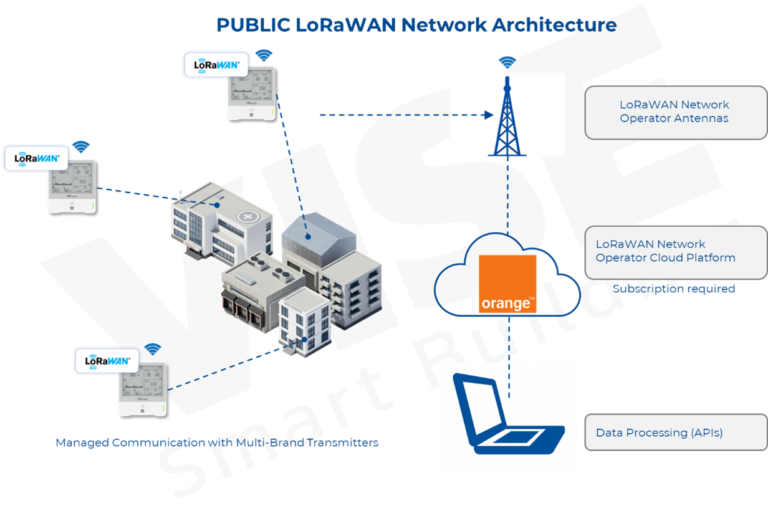
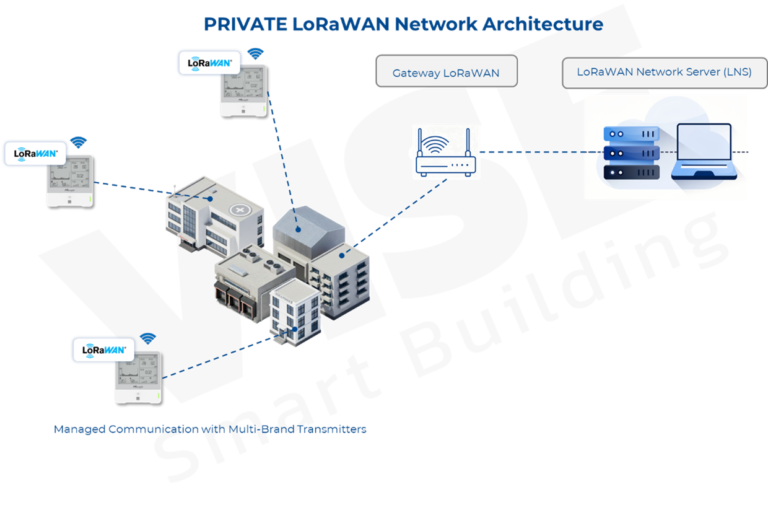
LoRaWAN networks can be implemented in two ways, each with distinct characteristics in terms of control, security, and cost structure.
| Aspect | 🌐 Public Networks | 🏢 Private Networks |
|---|---|---|
| Implementation | Connecting devices to an operator's existing network | Deploying a proprietary architecture (sensors, gateways, server) |
| Coverage | Extensive but depends on operator availability in the area | Adjustable based on company-specific needs, local gateways |
| Security | Depends on operator policies and protocols | Enhanced — customizable VPN, advanced encryption, direct control |
| Cost | Subscription-based model with recurring fees | Initial infrastructure investment, no recurring operator fees |
| Maintenance | Handled by the operator | Managed locally by the organization |
Managed by operators, these networks provide broad coverage shared among multiple users. However, in urban areas, coverage may be less effective due to physical obstacles (reinforced concrete, metal structures). Access typically involves a subscription with recurring costs.
Implemented and managed locally, offering full control over security, coverage, and data. In a BMS context, private networks are often preferred for customization and enhanced security. Ideal for industrial or sensitive environments where data sovereignty is critical.
Understanding LoRaWAN Device Classes
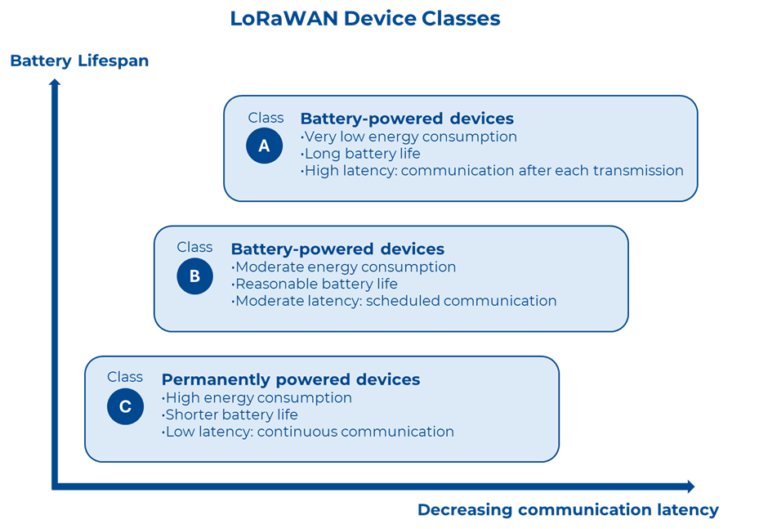
LoRaWAN defines three classes of IoT devices, each tailored to specific use cases — balancing energy consumption against communication responsiveness.
| Class | Characteristics | Example Applications |
|---|---|---|
| A | Low Energy · Asynchronous After each transmission, the device opens two short receive windows. Extended battery life but introduces latency depending on transmission interval. |
· Temperature sensors in technical spaces · Water / electricity meter readings · Water leak detection · Light sensors for non-critical areas |
| B | Moderate Energy · Scheduled Regular message reception due to additional receive windows with beaconing. Balanced energy and responsiveness. |
· Blind / shutter management · Humidity monitoring in storage · Presence sensors in parking lots · Temperature reporting in offices |
| C | High Energy · Always Listening Devices always in listening mode — minimal latency but higher power consumption. Typically requires mains power for continuous operation. |
· Access control and gate management · Gas / hazardous substance detection · Fire alarm systems · Real-time HVAC monitoring |
Why Choose LoRaWAN — and When Not To
LoRaWAN offers significant advantages for IoT and smart building projects, but understanding its limitations is equally important for making the right architectural decisions.
-
📡
Wireless ConnectivityEliminates complex cabling, reducing costs and simplifying installation.
-
🔌
InteroperabilitySeamless integration with a wide range of technologies and equipment.
-
📏
Long-Range CoverageUp to 5–10 km urban, up to 15 km rural, depending on propagation conditions.
-
🔋
Low Power ConsumptionDevices can operate for up to 10 years depending on transmission frequency.
-
📈
ScalabilityA single gateway can manage thousands of devices.
-
🔒
SecurityAES encryption + OTAA (Over-the-Air Activation) for secure device onboarding.
-
↔️
Bidirectional CommunicationBoth data upload and command/update reception for real-time device control.
-
⚡
Adaptive Data RateOptimizes network usage by adjusting rate and power based on distance and signal quality.
-
📦
Limited BandwidthOptimized for small data packets only. Not suitable for multimedia content or large payloads.
-
⏱
Latency (Class A)Class A devices may introduce transmission delays — not suitable for real-time critical applications.
-
⚖️
Two-Way Trade-offBidirectional communication is more responsive with Class B/C, but at the cost of significantly higher energy consumption.
LoRaWAN in Buildings: Key Applications
LoRaWAN enhances building management through a wide range of applications — improving both occupant comfort and operational efficiency.
While LoRaWAN can function independently, its efficiency is maximized when integrated into a Building Management System (BMS) — enabling centralized control and data correlation across all building systems.
Let’s Stay in Touch
CONTACT-US
- Have ideas or questions?
- Reach out using the contact form, or send us a message any time.